Loading
Showing posts with label Cuisine: Russian. Show all posts

Layered Vegetable Salad with Smoked Salmon

Layered smoked salmon salad / Suitsulõhega kasukas

"Kasukas" - "fur coat" - is a name for a layered vegetable salad that is very popular here in Estonia, especially during the cold and dark season. The salad has chopped cured herring as the bottom layer, topped with layers of grated or chopped beets, carrots, potatoes and other vegetables and "glued together" with thin layers of mayonnaise. The recipe - or rather an alternative way to serve the popular "rosolje" salad - came to Estonia from Russia in the second half of last century. In Russia "fur coat" aka "shuba" is still one of the most popular salads on the festive table (here's a lovely English-language blog post about the traditional "cured herring under fur coat"), and the un-layered "rosolli" is also a must on Finnish Christmas tables). Whereas I love beets, I dislike cured herring, so I tend to skip that salad on buffet tables. When making this at home, I'd usually make a double portion and divide the salad between two glass bowls - one with herring and the other without. Until I came across a version using smoked salmon in Natasha's Kitchen blog. That was about a year and a half ago, and since then I've made this salad over and over again and converted many kasukas-haters into kasukas-lovers.

Traditionally this salad is made and served in a big glass bowl that proudly shows off all the layers, and then it's spooned into serving plates (rather like a trifle). For a neater presentation, you may want to use individual glass bowls instead (see top photo). A note to my Estonian readers - I like making this with külmsuitsulõhe aka cold-smoked salmon (Pepe Kala makes a wonderful one!), rather than with kuumsuitsulõhe aka hot-smoked salmon.
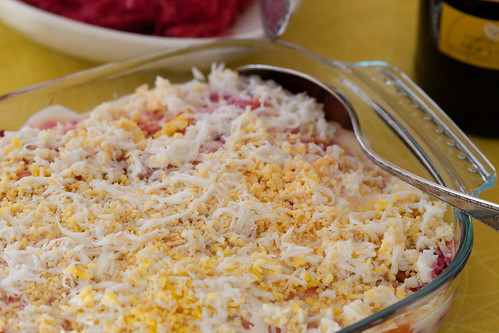
Suitsulõhega kasukas

Layered Smoked Salmon and Vegetable Salad
(Suitsulõhega kasukas)
Serves about 6 to 8
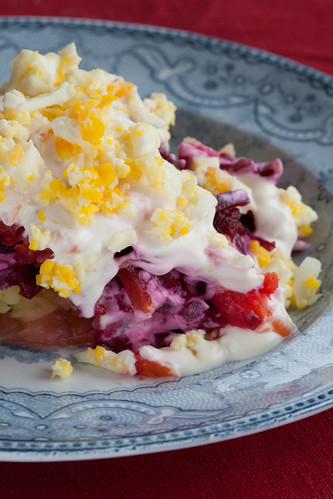
Kasukas suitsulõhega

200 g smoked salmon
400 g potatoes
1 small onion, peeled and finely chopped
200 g cooked beetroot (roasted, steamed or boiled)
250 g carrots
about 300-400 g good-quality mayonnaise
2 eggs

Boil (unpeeled!) carrots and potatoes until soft, but not mushy. Drain, cool a little, then peel.
Hard-boil the eggs, then cool and peel.

To compose the salad:
1. Cut the salmon into small pieces and scatter evenly at the bottom of a 2-litre (approximately 2-quart) glass bowl.
2. Grate the potatoes coarsely, scatter over the salmon.
3. Scatter chopped onion over the potato layer.
4. Gently spread about half of the mayonnaise over the onion layer.
5. Grate the beetroot coarsely, scatter over the mayonnaise layer.
6. Grate the carrots coarsely, scatter over the beetroot layer.
7. Spread rest of the mayonnaise over the beetroot layer.
8. Finely grate the eggs, scatter over the mayonnaise layer.

NB! As the mayonnaise is seasoned already, there is no need to season any of the layers with salt and pepper!

Cover the bowl with clingfilm and put into the fridge for a few hours for the flavours to combine (and the beetroot colour to stain the other layers :)) The salad can be happily made on a previous day as well, as it keeps rather well.

Layered vegetable salad with smoked salmon / Kasukas suitsulõhega

This recipe was also included in my latest cookbook, Jõulud kodus ("Christmas at Home"), published in Estonian in November 2011.
Follow RecipesDream

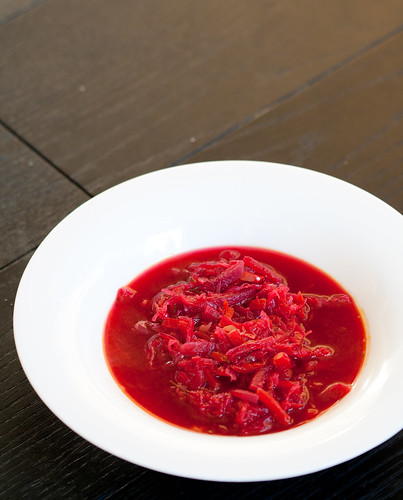
My favourite beetroot soup, vegetarian borscht

IMG_8446.jpg
October 2011

Here is one of my very favourite soups of all time, which I make about once a month (at least!). It's a vegetarian version of the famous Russian-Ukrainian beet soup, borscht. My version is delicious and heartwarming - brilliant for cold autumn days and dark winter nights. Yet it's light and refreshing enough, so it would also be good during summer. I tend to use sauerkraut during winter and plain white cabbage during summer (and prefer the first one).

Depending how good your knife-skills are, but it could be on your table in about 40 minutes or even less. I use the food processor to shred (or 'julienne') the vegetables.

My favorite beet soup
(Mõnus peedisupp, täitsa lihavaba)
Serves 4 to 6 as a main course


September 2007

400-500 g (about a pound) of beets
2 medium onions
2 large carrots
400-500 g (about a pound) white cabbage or mild sauerkraut
2 Tbsp olive oil
1.5 litres vegetable stock
1-2 Tbsp lemon juice or wine vinegar
sea salt and freshly ground black pepper

sour cream, to serve

finely chopped parsley or dill, to garnish

Peel the beets, onions and carrots. Cut all vegetables into thick matchsticks (you can use a food processor here to speed up the process). If using fresh cabbage, shred it thinly.
Heat the oil in a large saucepan, add carrots, beets, onions and a pinch of salt and saute for about 5 minutes, stirring every now and then.
Add the shredded cabbage or sauerkraut, then pour in the hot stock. Bring to the boil, reduce heat, cover, and simmer on a low heat for about 20-30 minutes, until vegetables are softened.
Season with salt, pepper and lemon juice, keeping in mind that a proper borscht should have a slightly acidic taste.
Serve with a dollop of sour cream (or omit, if you want a vegan soup) and sprinkle with some chopped parsley or dill.
Serve with some crusty (rye) bread.

UPDATE 21.9.2007
Hedgehog made this soup, too - check out her post here.

NOTE: This soup recipe was originally posted in September 2007. It's been fully revised and updated in November 2011.
Follow RecipesDream

Easter paskha for chocolate lovers

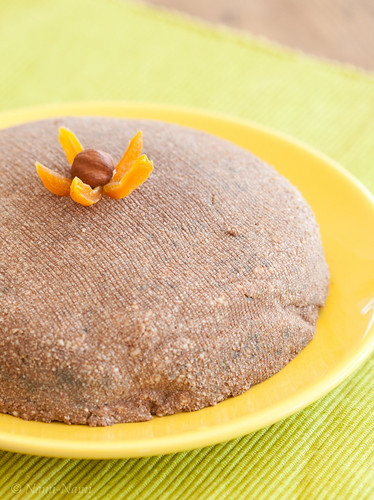
Chocolate paskha / Šokolaadipasha
Chocolate paskha, 2011, decorated with dried apricots

It's Easter Sunday this weekend and many a festive table will have a paskha (also spelled as 'pascha') as a centerpiece. We will, for sure.

Paskha is a sweet and rich curd cheese dessert that's traditionally served during Easter. I've shared two favourite recipes with you before - my traditional uncooked paskha with pistachio nuts and craisins and creamy cooked paskha with egg yolks. Here's another delicious paskha, especially for those of you who love chocolate!

Chocolate paskha
(Šokolaadisõbra kohupiimapasha)
Serves 8

Easter brunch / Kevadpühade brantš: Chocolate pashka / šokolaadisõbra kohupiimapasha
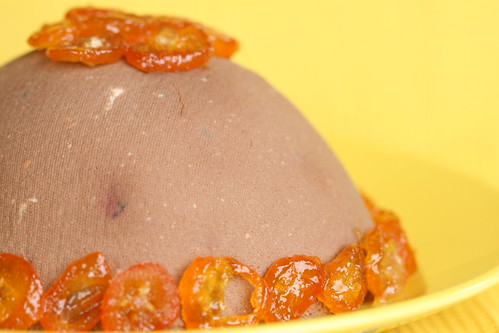
Chocolate paskha, 2009, decorated with candied kumquats

500 g curd cheese (kohupiim/tvorog) or ricotta
100 ml whipping cream
100 g dark chocolate, chopped
75 g butter, cut into cubes
50 g caster sugar
handful of dried apricots
handful of dried seedless raisins

Place raisins and apricots into a colander, pour over boiling water and drain thoroughly. Put aside.

Place cream, chocolate and butter into a small heavy saucepan and heat gently, stirring with a wooden spoon, until chocolate and butter are melted and you've got a luscious brown sauce. Remove the pot from the heat and immediately fold in the curd cheese, sugar, apricots and raisins. Mix until combined.

Line a special paskha-dish or a fine sieve with a double layer of cotton muslin that you've rinsed under cold water and wrung dry. Pour the curd cheese mixture into the dish, place a small plate on top. Place the filled paskha-dish over a bowl to collect any whey liquid that will drip out of the paskha.

To serve, turn the paskha onto a plate, remove the muslin and paskha dish or sieve.

 Decorate as you please - I love the contrast of chocolate-coloured paskha and something orange (apricots, candied kumquats etc).
Follow RecipesDream

Cod liver paté on toast

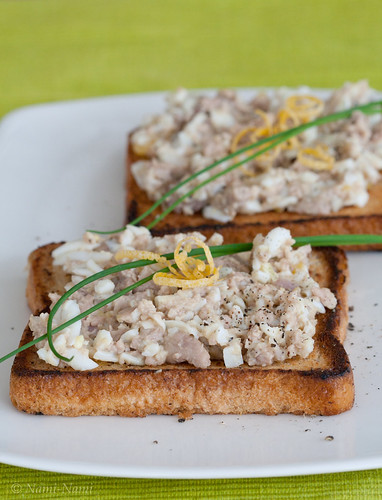
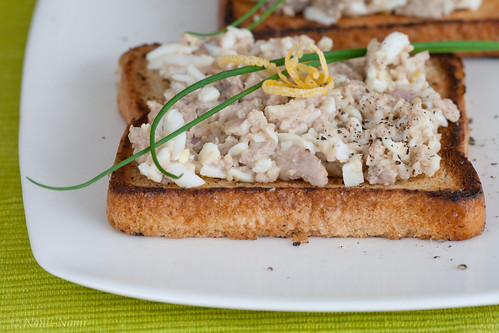
Cod liver toast / Tursamaksasalat

I've briefly mentioned cod liver on Nami-Nami previously - here and here, but it deserves a new post :) There are almost no blog posts on the topic - a FoodBlogSearch enquiry ends with plenty of posts about cod liver oil capsules, and just one food blog posts apart from mine, written by Rosie Dequattro (now available only in in cache) and a mention of foie de morue by Clotilde back in 2004 (!). I always keep a can of cod liver chunks in oil in the larder, as it's a great stand-by to have when you have unexpected friends. Or when you simply need a lunch in a hurry.

I got the recipe from my mum, but it's the same universal recipe used in pretty much every cod-liver-loving family in Estonia (or Russia, for that matter, as Rosie's post reveals). I love it on toast, but you can also serve it to fill vol-au-vents or top small crostini.

Cod Liver Paté
(Klassikaline tursamaksasalat)

Cod liver toast / Tursamaksasalat

190 g can cod liver chunks in oil (look for it in Russian markets)
1-2 eggs, boiled, peeled and finely chopped
a small (shallot) onion, finely chopped
salt and freshly ground black pepper

Drain the cod liver, then place in a small bowl and mash with a fork. Add the egg and onion, season with salt and pepper. (You can add some mayonnaise, if you want a smoother paté, but it's not really necessary).
Garnish with fresh herbs (dill, parsley and chives are especially fine here) and serve.
Follow RecipesDream

Russian syrniki aka curd cheese patties

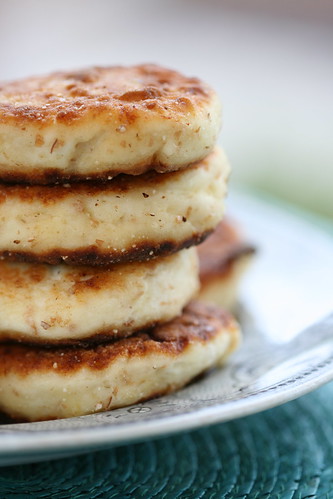
Curd  cheese patties / Sõrnikud

A little something from the Russian kitchen - fried thick curd cheese patties that are best enjoyed while still hot with a generous dollop of soured cream or a jam of your choice. You'll find curd cheese or quark cheese (tvorog, read more here) in Russian or Polish or German shops. Remember, the higher the fat content, the tastier the end result - or try farmer's cheese instead. Ricotta is too smooth and lean to work, in my opinion.

We love them for breakfast, but syrniki also make an excellent mid-day or mid-afternoon snack.

Syrniki
(Sõrnikud)
Serves 4

500 g curd cheese
2 egg yolks (or 1 egg, if you wish)
60 g plain flour (100 ml), or slightly more, if necessary
a generous pinch of salt
1 Tbsp sugar (for sweet syrniki)

flour for breading
oil for frying

Combine curd cheese, egg yolks, salt and sugar, if using.
Sprinkle some flour on the work surface and on your hands. Form small patties from the curd cheese mixture (add a spoonful or two of flour, if the mixture is too loose), flatten them slightly. The curd cheese patties should be about 1 cm thick.
(You could put them into the fridge for about and hour - it helps them to stay in shape).
Heat some oil on a frying pan over moderate heat. Fry the syrniki on both sides for 3-5 minutes, until they're golden brown.

Serve when still warm.
Follow RecipesDream

Salmon and Mushroom Solyanka (a thick Russian soup)

Salmon and mushroom solyanka / Seene-lõheseljanka

If you look around Estonian foodblogs, then we all seem to feast on thick and filling Russian-style mushroom soups at the moment - Tuuli has been cooking up mushroom borscht and mushroom rassolnik, Aet has a mushroom solyanka simmering in her saucepan. We had friends over for dinner last night, and as I had got a large bowl of blanched and slightly salted wild mushrooms from K's mum yesterday morning, and made a Russian-style mushroom soup as well, but with addition of fish.

You'll get a best result if using various wild mushrooms. Gypsy mushrooms (Rozites caperatus; kitsemamplid), Russula-mushrooms, Lactarius-mushrooms - all would be perfect, but cultivated mushrooms would work as well (perhaps a mixture of white mushrooms and shiitake mushrooms for some texture?). I had mainly meaty Lactarius scrobiculatus mushrooms (võiseened/kollariisikad)*, with an odd Russula thrown in.

Check your mushroom guide for instructions (some mushrooms - like gypsy mushrooms and many Lactarius-mushrooms can be cooked fresh, some need to be blanched first.

* Note that Wiki considers this an inedible mushroom (well, "Western authors" do). It's much liked over here for its meaty texture and characteristic flavour. It does need to be thoroughly blanched and cooked first, however, and smaller mushrooms are preferred to larger ones.

Mushroom and Salmon Solyanka
Serves four to six

Mushroom and salmon solyanka / Lõhe-seeneseljanka

1 large onion, peeled and chopped
about 400 g fresh (wild) mushrooms - pre-blanched, if necessary
2 Tbsp rapeseed or olive oil
3 Tbsp concentrated tomato pureé
1 litre fish stock
4 medium-sized potatoes, peeled and chopped
300 g salmon filet, cut into 1 cm cubes
2 small pickled cucumbers, halved lengthwise and cut into slices
2 Tbsp capers
a small bunch of dill
salt
black pepper
lemon juice, to taste

Heat oil in a saucepan, add onion and mushrooms and sauté for about 5 minutes.
Stir in the tomato paste, cook for a minute or two.
Pour in the fish stock, bring to the boil. Add the potato cubes, then simmer for about 15 minutes, until the potatoes are cooked.
Add fish, capers, cucumber slices and most of the dill. Simmer for another few minutes, then remove the saucepan from the heat.
Season to taste with lemon juice, salt and pepper (solyanka needs a slightly sour note!).
Sprinkle some extra dill on top, garnish with lemon slice or wedge and serve.
Follow RecipesDream

Cold Beetroot Soup (kind of Chlodnik or Холодник)

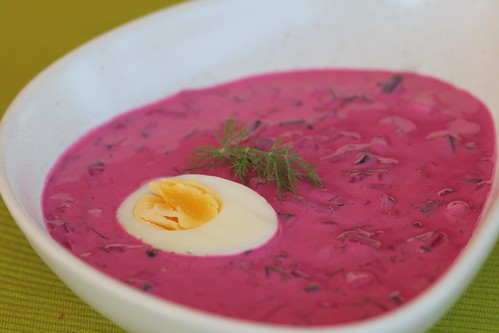
Cold Russian beet soup / Holodnik / Külm peedisupp

Although the tropical heat wave has given way to a beautiful Estonian summer (temperatures at around 25 C, with some
showers), it's still warm here in Estonia. Perfect excuse for eating lots of cold summer soups. My cold soup repertoire isn't huge, I must admit. I love Ximena's gazpacho (and will be making it again and again in a week or so, when our tomatoes are ready). I also love this simple cold kefir soup with herbs and radishes. But radishes are finished for this year, so I needed a new cold soup recipe. The recipe here is slightly adapted from this Russian foodblog, and we loved both the flavour as well as the stunning colour. Our little daughter, who's almost 1 year and 6 months now, heartily approved as well!!

I love roasting the beets, as this gives them an exceptionally sweet and earthy flavour. If you're short for time, then this works with boiled (and even ready-grated and vacuum-packed) beets as well.

Cold Beet Soup with Kefir
(Külm peedisupp)
Serves four to six

Cold Russian beet soup / Holodnik / Külm peedisupp

3 small beets, each about the size of a tennis ball
2 short green cucumbers ("Lebanese cucumbers")
handful of green onions, chopped
3-4 Tbsp finely chopped fresh dill
1 litre kefir
1 Tbsp grated horseradish
salt, to taste
freshly ground black pepper, to taste
2-4 eggs

Wash the beets, wrap in foil and roast in a 200 C oven for about 45 minutes, until cooked through (test for doneness by piercing with a sharp knife). Cool completely, then peel and grate coarsely.
Hard-boil the eggs, then cool under cold water. Peel and cut into half lengthwise.
Wash the cucumbers, cut into small dice.
Take a large bowl, throw in the grated beets. Stir in some of the kefir, then season the soup base with horseradish and some salt and pepper. Add the rest of the ingredients, except boiled eggs. Taste again for seasoning - you may want to add more salt or pepper, or perhaps even some lemon juice.
Serve very cold, topping each portion with a boiled egg half or two.

Keeps well in the fridge for a day or two.
Follow RecipesDream

Buckwheat Kasha with Mince

Following from yesterday's buckwheat theme, here's another recent buckwheat dish we recently enjoyed. We do love buckwheat kasha or porridge as it is, and eat it occasionally as a side dish to some grilled pork. But sometimes it's nice to spice it up with a little extra. Adding pork or beef mince to the kasha is one way of making a humble side dish into a delicious main course.

Note that buckwheat is naturally gluten-free, so it's a suitable and tasty grain alternative to all those who need to avoid gluten.

Buckwheat Kasha with Mince
(Tatrapuder hakklihaga)
Serves 6


250 g mince (I used a mixture of pork and beef)
1 small onion, peeled and chopped
2 carrots, peeled and coarsely grated
400 g buckwheat groats
oil for frying
1 litre of water, boiling
salt
freshly ground black pepper

Heat the oil on a frying pan over high heat, add the mince and brown, stirring every now and then.
Reduce the heat to moderate, add the carrot and onions, season with salt and pepper
and cook for 5 minutes to slighly soften the onions.
Heat some oil in a large heavy saucepan, add the buckwheat groats and toast them for about 5 minutes, stirring to coat and toast evenly.
Add the fried meat and onion mixture to the buckwheat groats, give it a stir and pour over the boiling water.
Cover the saucepan and simmer on a low heat for 30-40 minutes, until buckwheat groats are soft.
Serve hot with sliced pickled cucumbers and cold horseradish and sour cream sauce*.

* To make the cold horseradish sauce grate some fresh horseradish, add enough sour cream to achieve the consistency and potency you like and season with salt.

LEFTOVERS? No worries - simply heat the cold buckwheat kasha in some oil or butter on the following day.
Follow RecipesDream

Russian Vinaigrette Salad, and confusion with culinary terms

Vinaigrette is the oil-and-vinegar dressing so popular across the world for livening up salad leaves, right? Wrong, at least as far as the vast Russia is concerned. And Estonia, for that matter. Most deli counters in supermarkets here would sell something called 'vinegrett' (that's vinaigrette in the local lingua), and it's not the dressing they're selling, but this bright Russian vegetable salad. My version is possibly a bit beetier (khm? is that a word?) than others, but I simply couldn't resist the colour.

Note the Russian vinaigrette salad is lactose free/gluten free/vegetarian/vegan, so should suite a wide array of diets- in addition of being really bright and beautiful to look at. I served it on crisp dark rye bread triangles, but usually it is eaten just as a side salad.

Russian Vinaigrette Salad
(Köögiviljavinegrett)
Serves 10 as a side dish


300 g boiled potatoes
200 g boiled beets
100 g boiled carrots
300 g sauerkraut
200 g pickled or salted cucumbers
150 g red or yellow onions or spring onions

Dressing:
5 Tbsp vegetable oil
2 tsp strong mustard
a generous squeeze of lemon juice*
salt
sugar
coarsely ground black pepper

fresh herbs (e.g. dill, parsley, chives)

NB! All cooked/boiled vegetables must be cool before starting to prepare the salad.

Peel the potatoes, beets and carrots and cut into thin julienne sticks or grate coarsely. Cut the cucumbers into thin slices lengthwise, then cut into stick crosswise. Mince onion finely.
Mix gently all the vegetables (sauerkraut, beets, carrots, cucumbers, onions) in a large bowl, until well combined.
Season the vegetables with salt, then dress with oil, mustard and lemon juice. Check for seasoning - and add salt, sugar and/or pepper, if necessary. The vinaigrette salad should have a slightly sweet-and-sour flavour.
Put into the fridge for about an hour, so the flavours and colours could mingle.
Sprinkle generously with fresh herbs and serve.

* It is traditional to use vinegar, but we prefer the much milder lemon juice.

VARIATIONS TO THE THEME:
You may add any of the following ingredients:
* fresh or preserved green peas
* salted Baltic herring slices (place on top of the salad)
* chopped salted wild mushrooms (add about 25 g per person)
* chopped hot-smoked fish
* chopped fresh or pickled apples
* chopped bell peppers (add about 100 g to the above recipe)
Follow RecipesDream